Germany World Cup 2026 Preview: Squad, Odds & Best Bets

Contents
- Germany World Cup 2026 Preview: Squad, Odds & Best Bets
- Germany at the World Cup: A Quick Snapshot
- Road to World Cup 2026
- Projected Germany Squad for 2026
- Key Players to Watch
- Tactical Analysis: How Germany Will Play
- Strengths & Weaknesses
- Pros & Cons Summary: The Germany World Cup 2026 Squad
- Germany World Cup 2026 Odds
- Best Betting Angles for Germany
- Prediction: How Far Can Germany Go?
- Final Verdict
- Frequently Asked Questions
 Best Bookmakers for United States





KEY TAKEAWAYS:
- Wirtz and Musiala are the tournament’s most exciting partnership — if both are fit.
- The defense is the elephant in the room.
- The pressure of history demands more than quarter-finals.
Germany at the World Cup: A Quick Snapshot
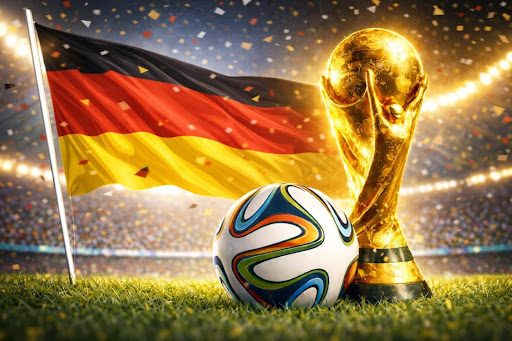
Four titles — 1954, 1974, 1990, and 2014. A record of sustained excellence that no European nation can match. Germany’s tournament pedigree is extraordinary, and its ability to peak at the right moment — grinding through groups, winning shootouts, producing heroes when it matters most — has been one of the great constants of international football.
The recent record tells a different story. Germany has failed to pass the group stage since their 2014 triumph — eliminated at the group stage in both 2018 and 2022 in deeply embarrassing circumstances. Euro 2024 on home soil offered genuine encouragement, with a quarter-final run that showed signs of a new identity taking shape. The challenge now is turning that promise into a genuine deep tournament run.
Road to World Cup 2026
“Die Mannschaft” eased through World Cup 2026 qualification with five wins from six games, topping its group comfortably. On the surface, an impressive campaign. Beneath it, the results against weaker opposition masked issues that stronger opponents will look to exploit.
Germany kept a clean sheet in only seven of its last 25 games at one point during the cycle, a statistic that has driven persistent debate about the defensive structure. A 0-2 defeat to Slovakia in 2025 ignited discussion about Nagelsmann’s constant tactical changes and whether consistency of approach was being sacrificed for experimentation.
The March 2026 friendly window produced a thrilling but instructive 4-3 win over Switzerland — a result that encapsulated both Germany’s attacking potential and its defensive fragility in a single game.
Projected Germany Squad for 2026
Goalkeepers: This is the most uncertain position in the squad. Manuel Neuer has retired from international football, and Marc-André ter Stegen has suffered serious injuries, leaving his availability for the tournament in doubt. That has opened the door for Hoffenheim’s Oliver Baumann, who started all six World Cup qualifiers and is the current frontrunner for the number one shirt. Alexander Nübel provides cover, while a return to fitness for Ter Stegen before the tournament would change the situation considerably — if he’s fit, he’s expected to go to North America.
Defenders: Captain Joshua Kimmich plays at right-back under Nagelsmann, providing experience and quality in a position that doubles as a creative outlet. Nico Schlotterbeck has emerged as the preferred center-back partner for Jonathan Tah, although an injury-disrupted season has created concerns about his consistency. Antonio Rüdiger’s experience and leadership remain valuable, though he too has dealt with fitness issues at Real Madrid. David Raum starts at left-back, with young Nathaniel Brown of Eintracht Frankfurt pushing for a place after an impressive season.
Midfielders: Nagelsmann has largely settled on a 4-2-3-1 formation, with Joshua Kimmich and Aleksandar Pavlović likely to operate in the double pivot. Leon Goretzka provides experienced cover. Injury permitting, Jamal Musiala and Florian Wirtz will line up alongside each other in the final third — forming one of the most talented attacking midfield partnerships in world football. Musiala has been working his way back from a broken leg suffered at the Club World Cup, making his fitness the single most important squad question heading into June.
Forwards: Kai Havertz operates in the false nine or as a supporting striker. Nagelsmann is understood to want an old-school number nine as a late-game option, with Niclas Füllkrug and Tim Kleindienst competing for that role if available. Leroy Sané and Serge Gnabry offer a wide range of options with pace and experience.
Key Players to Watch
Florian Wirtz is the heartbeat of Germany’s attack. Ranked as the best attacking midfielder in the world by some metrics, Wirtz consistently produces his best football in a Germany shirt and will be the primary creative force throughout the tournament. His ability to operate in tight spaces, drive at defenders, and deliver in the final third makes him unplayable on his day.
Jamal Musiala — fitness permitting — is the player who elevates Germany from contenders to genuine threats. His combination with Wirtz creates problems that no defensive system has reliably solved. After recovering from a serious injury, his return to form will be closely watched in the weeks leading up to the squad announcement.
Joshua Kimmich provides the experience, leadership, and tactical intelligence that holds the whole structure together. His ability to read the game, cover defensive positions, and drive forward from deep makes him Germany’s most complete outfield player.
Jonathan Tah has developed into one of the most composed center-backs in the Bundesliga and will be asked to organize a backline that has shown vulnerability. His partnership with Schlotterbeck is the most important defensive relationship in the squad.
Tactical Analysis: How Germany Will Play
Nagelsmann has settled on a 4-2-3-1 as his base formation, though he has the personnel to shift to a back three when the game demands it. The system is built on gegenpressing — rapid, organized pressure when the ball is lost — and possession-based build-up when Germany has the ball.
The system’s strength lies in its attacking fluidity. When Wirtz and Musiala are both fit and in form, the combination of their movement, interplay, and individual quality creates relentless problems. Havertz’s ability to drop deep and link play adds another dimension.
The weakness is the transition between defensive phases. Germany’s defensive record — keeping clean sheets in only seven of 25 games at one stage — reflects a system that is more comfortable in possession than out of it. The double pivot needs to function as a genuine defensive shield, and the center-back pairing needs to handle physical pressure from top-tier strikers, as they haven’t consistently done so in recent cycles.
Germany legend Philipp Lahm has warned about defensive complacency, noting that nations who fail to adapt defensively risk being left behind — a message clearly directed at the current setup as the tournament approaches.
Strengths & Weaknesses
Germany’s strengths are concentrated in the attacking third. The Wirtz-Musiala partnership is elite. Kimmich’s experience provides leadership throughout the team, and Nagelsmann’s pressing system creates high-tempo games that suit Germany’s physical and technical profile.
The weaknesses are structural and persistent. The defense isn’t as dominant as in past eras, and the goalkeeper situation depends heavily on fitness outcomes that remain uncertain. The lack of a consistent, elite number nine means Germany can struggle when opponents defend deep and deny space in behind. And the broader question — whether Nagelsmann can build a settled, coherent unit after years of tactical experimentation — remains genuinely unanswered with weeks to go before the tournament begins.
Pros & Cons Summary: The Germany World Cup 2026 Squad
Germany arrives at the 2026 World Cup with genuine attacking firepower and a settled tactical vision under Nagelsmann — but with defensive vulnerabilities and a goalkeeper crisis that have dogged the squad for years now. The rebuild is real, the talent is there, but the structural questions remain stubbornly unanswered. Here’s the honest assessment.
| Pros | Cons |
|---|---|
| Wirtz-Musiala partnership — When both are fit, this is the most exciting attacking midfield combination at the tournament. Capable of unlocking any defense and winning games on their own. | Goalkeeper uncertainty — Neuer retired, Ter Stegen is racing to recover from injury, and Baumann — while reliable — isn’t the commanding, world-class presence Germany has relied on for decades. |
| Kimmich’s leadership — The captain provides experience, tactical intelligence, and positional flexibility that holds the entire structure together across the pitch. | Defensive fragility — Keeping clean sheets in only seven of 25 games is not the record of a side built to win a World Cup. The backline remains susceptible in transition against top-tier opposition. |
| Settled tactical system — Nagelsmann’s 4-2-3-1 and gegenpressing setup is well-drilled and suits the personnel, giving Germany a clear identity heading into the tournament. | Musiala injury doubt — Germany’s second-most important player is racing to prove his fitness after a serious injury. His absence would fundamentally reduce the team’s attacking ceiling. |
| Favorable group draw — Curaçao, Côte d’Ivoire, and Ecuador give Germany every opportunity to build momentum, manage minutes, and arrive at the knockouts in good shape. | No reliable number nine — Without a consistent elite striker, Germany can struggle to break down deep defensive blocks — a problem that repeatedly surfaces in knockout football against organized opposition. |
Germany World Cup 2026 Odds
Germany is typically priced in the 9.00 to 13.00 range for outright victory — firmly in the conversation as one of the top six or seven favorites, but with a price that reflects defensive concerns and their recent group-stage exits. The market respects the attacking quality while discounting the structural vulnerabilities.
What could shorten them? Musiala returning to full fitness before the tournament would attract significant market confidence. A strong group stage performance could see money arrive at shorter prices. A defensive collapse or an early injury to Musiala would push them out considerably. “Die Mannschaft” is in Group E alongside Curaçao, Ivory Coast, and Ecuador — a group it should navigate comfortably and use to build momentum.
For the full range of tournament markets, visit the leading FIFA bookmakers.
Best Betting Angles for Germany
Germany to reach the quarter-finals — The realistic floor expectation given the group draw and attacking quality. Solid value for what should be a manageable route to the last eight.
Germany to win its group — Against Curaçao, Côte d’Ivoire, and Ecuador, Germany is a strong favorite to top the group. A reliable if ungenerous market.
Florian Wirtz as the top goalscorer/assists — The creative engine of the team, playing in a system designed to get the best from him. His goal and assist contributions across a full tournament could be significant. Worth exploring in both the goals and assists markets.
Each-way: Germany to win the tournament — At 10/1 or above, there’s genuine each-way value. If Musiala is fit, the Wirtz-Musiala partnership is capable of winning games against any opposition. The defensive concerns keep the price interesting.
Prediction: How Far Can Germany Go?
Realistically, Germany should reach the quarter-finals and is capable of going deeper if the fitness picture clarifies favorably. A semi-final is achievable. Winning the tournament outright would require defensive improvement and Musiala at his absolute best — both possible, neither guaranteed.
The most likely scenario is a smooth group stage, a competitive last-16 tie, and a quarter-final against one of the tournament’s elite sides where Germany’s attacking quality is tested against organized, physical opposition. How the defense holds up in that match will determine everything.
Final Verdict
Germany is a team in transition that’s capable of punching above where that transition currently sits. The attacking talent of Wirtz and Musiala gives them match-winning ability against anyone. The goalkeeper uncertainty, the defensive inconsistency, and the weight of expectation from a nation that considers anything short of the semi-finals a failure create a volatile mix heading into the summer.
Back them to go deep, but do so with eyes open. Germany at a World Cup is never straightforward — and this year, that has rarely been more true.
Frequently Asked Questions
Latest Tips
France vs Italy
The FIVB Men’s Volleyball Nations League (VNL) is one of the most prestigious annual international volleyball competitions, bringing together the world’s top national teams across several weeks of eli...
Read More
Uzbekistan - Colombia
One of the two opening matches in Group K of the 2026 FIFA World Cup between Uzbekistan and Colombia presents a fascinating, high-stakes collision between Asian tactical discipline and South American ...
Read MorePortugal - Congo
The 2026 FIFA World Cup Group K opening match between Portugal and DR Congo represents a massive clash of styles, experience, and footballing history. As you prepare to watch the action unfold, you ca...
Read MoreEngland - Croatia
Few group-stage fixtures at this World Cup carry the emotional and competitive weight of this one. Before diving in, if you want to compare odds and markets from top-rated sportsbooks for this fixture...
Read MoreLatest News
One-time TI champions Tundra Esports End Competitive Operations to Pursue Media-First Future
Tundra Esports has announced one of the most surprising pivots in recent eSports memory, stepping away from competitive gaming entirely and repositioning itself as a media-focused brand. The move come...
Read More1xBet Wins SiGMA Europe Awards for Best Sports Betting Operator in 2026
Global betting operator 1xBet has been crowned Best Sports Betting Operator 2026 at the SiGMA Europe Awards, which took place in Valletta, Malta. The ceremony, held at the historic Casino Maltese, bro...
Read MoreManchester United and Betway Strike Major Sponsorship Deal as Iconic Club’s Commercial Strategy Evolves
Manchester United have agreed a new sponsorship partnership with Betway, marking another significant commercial move for one of football’s most recognizable brands. The agreement adds Betway to United...
Read MoreFIFA World Cup 2026 to Debut Major Rule Changes: VAR Powers Expanded, Time-Wasting Targeted…
The 2026 FIFA World Cup is set to become the testing ground for some of the most significant football law changes in recent years after the International Football Association Board (IFAB) approved a p...
Read More