
Asian Handicap Explained: How to Use It at the World Cup

Contents
- Asian Handicap Explained: How to Use It at the World Cup
- The Draw Is the Problem — Asian Handicap Is the Fix
- Quarter Handicaps: The Part Nobody Explains Properly
- Why World Cup Football Suits This Market
- Reading the Line Movement
- Knockout Rounds Are a Different Animal
- Pros & Cons of Asian Handicap World Cup Betting
- One Practical Note
- Frequently Asked Questions
KEY TAKEAWAYS:
- Asian handicap removes the draw — unlike standard 1X2 betting, you’re always backing one side, which makes markets tighter and odds more valuable, especially when backing short-priced World Cup favorites.
- Quarter-goal lines (-0.25, -0.75) give you built-in flexibility — your stake is split across two bets, so a one-goal win can still return half your profit rather than a straight loss, useful when you’re confident in a winner but not the margin.
- Context shapes the right line to use — group stage games favor bigger handicaps on dominant teams, while knockout rounds call for tighter lines (0 or ±0.5) given the cautious, low-scoring nature of elimination football.
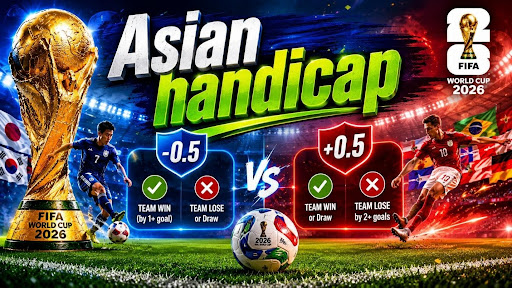
The Draw Is the Problem — Asian Handicap Is the Fix
Standard 1X2 betting has three outcomes. That means even when you’re highly confident about who wins a game, you’re splitting potential return across a market where the draw eats into your probability. In group-stage football, especially when teams manage results, play for draws, or sit back after going ahead, that third outcome is a genuine liability.
Asian handicap removes it. You’re either backing one team or the other, with a head start applied to level things out. Simple in theory. The complexity comes from the way those handicaps work in practice.
A whole number handicap — say, Brazil -1 — means Brazil has to win by at least two goals for your bet to land. Win by exactly one, you lose. No push, no refund. A half-goal handicap (-1.5) follows the same logic but is even cleaner: there’s no ambiguous result. Win by two or more, you’re paid. Win by one, you lose.
Where it gets interesting is the quarter-goal lines.
Quarter Handicaps: The Part Nobody Explains Properly
A -0.75 handicap sounds abstract, but it’s actually just splitting your stake across two bets: half goes on -0.5, half on -1. If your team wins by exactly one goal, you win the first half and push on to the second, meaning you get half your stake back at a profit. Win by two or more, both halves win. Lose or draw, you lose everything.
This is the Asian handicap’s version of hedging, built into a single bet. It’s useful at the World Cup when you think a strong team will win but aren’t sold on a big margin — think France against an African qualifier, or Spain in a tight group game. You’re not fully committed either way, and the quarter line reflects that middle ground.
Some books also offer +0.25 on the other side, which means your bet half-wins even on a draw. That’s occasionally the right play when you respect an underdog but expect them to lose narrowly.
Why World Cup Football Suits This Market
Group stage dynamics at the World Cup create unusual incentive structures. Teams protect results. A 1-0 lead in the 70th minute often becomes a defensive exercise rather than a push for more. Scorelines are compressed by design — coaches aren’t trying to run up tallies, especially when disciplinary records affect who makes the knockout rounds.
That context is exactly where Asian handicap earns its place. Backing a heavy favorite on straight match odds might give you 1.25 or 1.30. Backing them on a -1 Asian handicap suddenly looks like a much better value if you believe they’ll control and win comfortably. The odds shift materially. And if you’re not confident, they’ll win by two? Take the -0.5 at a shorter price, or the -0.25 to build in some buffer.
If you’re planning to follow this throughout the tournament, it’s worth choosing a platform that offers competitive Asian handicap lines throughout the group stage and knockouts; the soccer World Cup betting site we singled out breaks down which bookmakers have the best coverage and where the lines tend to be sharper.
Reading the Line Movement
One thing experienced bettors do is watch how Asian handicap lines move in the 24-48 hours leading up to a game. A line shifting from -1 to -1.5 on a favorite tells you something — either sharp money came in on the favorite, or the book is managing exposure. The opposite movement suggests confidence flowing toward the underdog.
At a World Cup, this matters because squad news, rotation hints, and press conference comments all filter into the market quickly. A manager who confirms he’s resting three starters makes that -1.5 line on his team a lot less attractive. Line movement is effectively a second layer of information, on top of whatever research you’ve done yourself.
Asian handicap World Cup betting is particularly sensitive to this because the margins are tighter than they look. Half a goal on the handicap line is the difference between a winning and losing bet more often than people expect.
Knockout Rounds Are a Different Animal
Everything shifts once the group stage ends. In knockout football, teams don’t just accept defeat — there’s no second chance, no points cushion. The tactical profile changes, games become more cautious, and low-scoring affairs are common.
For Asian handicap purposes, that means the 0 line and small handicaps (-0.5, +0.5) become more relevant than big spreads. Backing a slight favorite at 0 — meaning your stake is returned on a draw, and you win if they win — is a legitimate play in tight knockout games. It’s essentially match betting but without the downside of the draw.
Heavy handicaps in knockout rounds require more conviction. A -1.5 on any team in a World Cup quarterfinal carries real risk regardless of the teams involved. The stakes are different once elimination is on the table.
Pros & Cons of Asian Handicap World Cup Betting
| Index | Pros | Cons |
|---|---|---|
| Market structure | Eliminates the draw, so you’re never losing to a result you didn’t back | Fewer outcome options mean less flexibility for certain betting angles |
| Odds value | Consistently better prices than 1X2 on favorites | Quarter-line splits can confuse new bettors and lead to miscalculated stakes |
| Risk management | Quarter handicaps allow partial returns — you don’t always lose your full stake | Half-goal lines leave no margin for error; a one-goal win on -1.5 is still a loss |
| World Cup fit | Ideal for group stage mismatches where favorites are heavily priced on match odds | Knockout round dynamics make big handicap lines risky regardless of team quality |
| Line movement | Tracking shifts gives useful information about where sharp money is going | Requires active monitoring — lines can move significantly close to kickoff |
| Learning curve | Once understood, it’s more intuitive than most Asian betting formats | Initial complexity puts off casual bettors who stick to simpler markets |
One Practical Note
Asian handicap World Cup betting rewards specificity. Vague opinions — “I think Germany will win” — don’t translate well into this market. You need a view on the margin, on how a game will be played, on whether a team will push for goals or protect a lead. That specificity is part of what makes it more engaging than standard match betting. You end up thinking about games more carefully, which is usually where the edge lives anyway.
The format rewards effort. That’s probably why it’s become the default market for more experienced football bettors. It’s not complicated — it just looks that way at first.
Frequently Asked Questions
Latest Tips
France vs Italy
The FIVB Men’s Volleyball Nations League (VNL) is one of the most prestigious annual international volleyball competitions, bringing together the world’s top national teams across several weeks of eli...
Read More
Uzbekistan - Colombia
One of the two opening matches in Group K of the 2026 FIFA World Cup between Uzbekistan and Colombia presents a fascinating, high-stakes collision between Asian tactical discipline and South American ...
Read MorePortugal - Congo
The 2026 FIFA World Cup Group K opening match between Portugal and DR Congo represents a massive clash of styles, experience, and footballing history. As you prepare to watch the action unfold, you ca...
Read MoreEngland - Croatia
Few group-stage fixtures at this World Cup carry the emotional and competitive weight of this one. Before diving in, if you want to compare odds and markets from top-rated sportsbooks for this fixture...
Read MoreLatest News
Iran Warns of World Cup Match Disruptions Amid Growing Political Tensions
With the 2026 FIFA World Cup set to begin on June 11, controversy surrounding Iran’s participation has intensified after Iranian officials warned, “minutes” leading to the competition start, that matc...
Read MoreOne-time TI champions Tundra Esports End Competitive Operations to Pursue Media-First Future
Tundra Esports has announced one of the most surprising pivots in recent eSports memory, stepping away from competitive gaming entirely and repositioning itself as a media-focused brand. The move come...
Read More1xBet Wins SiGMA Europe Awards for Best Sports Betting Operator in 2026
Global betting operator 1xBet has been crowned Best Sports Betting Operator 2026 at the SiGMA Europe Awards, which took place in Valletta, Malta. The ceremony, held at the historic Casino Maltese, bro...
Read MoreManchester United and Betway Strike Major Sponsorship Deal as Iconic Club’s Commercial Strategy Evolves
Manchester United have agreed a new sponsorship partnership with Betway, marking another significant commercial move for one of football’s most recognizable brands. The agreement adds Betway to United...
Read More