
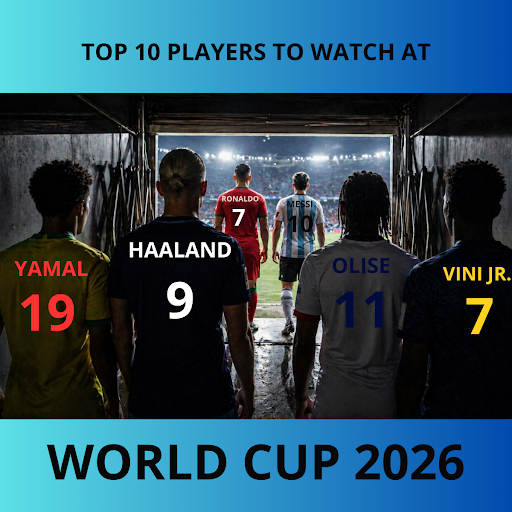
Top 10 Players to Watch at World Cup 2026

Contents
KEY TAKEAWAYS:
- The shift is already happening. The spotlight is moving away from the Messi–Ronaldo era toward a new generation of FIFA World Cup players who are more fluid, versatile, and less tied to traditional roles.
- Unpredictability will define 2026. With more teams and evolving playstyles, the tournament is likely to reward players who can adapt quickly—those who can change games in moments, not just control them over 90 minutes.
- Breakout stars matter as much as superstars. Established names like Mbappé and Vinícius will dominate headlines, but players like Yamal or Olise could end up shaping the tournament just as much—if not more.
10. Pedri – The Game’s Quiet Architect
Pedri doesn’t chase the spotlight, which is probably why people underestimate how much he controls matches. Watch closely, and you’ll see it—angles opening, pressure escaping, tempo shifting without any obvious trigger.
Spain’s identity still leans heavily on midfield intelligence, and Pedri is central to that. Not flashy, not dominant physically, but constantly dictating how the game breathes.
Among modern FIFA World Cup players, he’s the kind who wins you games without ever looking like he’s trying to.
9. Michael Olise – The Unpredictable Spark
Olise feels like the type of player who could arrive at a World Cup and suddenly become the storyline. Not the most hyped going in, but impossible to ignore once things start.
He plays with a kind of freedom that doesn’t always translate in rigid systems—but tournaments tend to loosen those structures. If France gives him space, he could unlock matches that otherwise stay stuck.
And those are the matches that define tournaments.
8. Ousmane Dembélé – Chaos, Refined (Maybe)
Dembélé has always been chaos. The difference now is that it’s becoming… slightly more controlled.
Still unpredictable, still capable of doing something completely unexpected—both brilliant and baffling—but there’s more maturity in how he chooses his moments. Better timing. Fewer forced plays.
If that balance holds, he becomes one of the most dangerous wide players among FIFA World Cup players in 2026. France is so lucky to have him.
7. Harry Kane – The Finisher Who Thinks Like a Midfielder
Kane’s game has shifted over the years. He’s no longer just waiting in the box—he drops deep, links play, and then still finds a way to end up on the scoresheet.
That dual role matters in tournament football. When games tighten, having a striker who can create and finish becomes a real edge.
England’s ceiling might depend on how well Kane balances those responsibilities under pressure.
6. Federico Valverde – The Relentless Runner
Valverde doesn’t stop. That’s really it.
He covers ground, drives forward, tracks back, shoots from distance—he’s involved in everything without necessarily dominating headlines. Uruguay has always leaned on intensity, and he fits that identity perfectly.
Over the course of a long tournament, players like him become more valuable with each round.
5. Lautaro Martínez – The System Finisher
Lautaro thrives in structure. He presses, links play, finishes moves rather than forcing them. That makes him ideal for tournament football, where efficiency matters more than volume.
He’s not always the headline name in Argentina’s attack, but he might be the one converting the chances that actually decide matches.
If Argentina builds rhythm early, he could quietly rack up goals.
4. Vinícius Júnior – The Momentum Breaker
Vini doesn’t just beat defenders—he shifts entire matches. One burst of acceleration, one moment of imbalance, and everything changes.
Brazil feeds off that kind of energy. Always has.
And when you start looking at patterns—form, momentum, even how squads are evaluated across platforms like the best betting site for World Cup—players like Vini tend to tilt expectations quickly. One action is enough.
3. Erling Haaland – The Pure Finisher
Given that he netted 16 times in UEFA qualifiers, there was no chance Haaland would miss the tournament, as his presence in Norway’s impeccable campaign (eight matches, eight wins) was crucial. No other player scored more goals in European qualifications. Who didn’t expect that, right?. After that, he immediately became one of the most talked-about FIFA World Cup players.
Haaland doesn’t need many touches. Doesn’t drift wide or orchestrate buildup. He finishes. That’s the role.
In tournament football, where chances are limited, that can be everything.
2. Kylian Mbappé – The Inevitable Threat
Mbappé feels inevitable at this point.
Even when teams set up specifically to stop him—deeper lines, double coverage—he still finds space. Still finds moments.
He’s already delivered on the biggest stage, repeatedly. And if anything, he’s entering the phase where everything becomes more consistent. Can he top his performance from the last World Cup, when he showed a monstrous display in the final (yet not enough for the title)? Absolutely!
1. Lamine Yamal – The Unpredictable Future
Yamal at number one might feel early. Maybe even a bit risky.
But that’s the point.
He plays without hesitation, without the weight that usually comes with big tournaments. That freedom—especially in a young player—can be difficult to defend against because there’s no clear pattern yet.
If he finds rhythm early, he could become the breakout name of the tournament. The one that defines the next wave of FIFA World Cup players. Just like he did for Spain two years ago.
Or maybe not. That uncertainty is part of it.
Honorable Mentions: The End of an Era
This tournament isn’t just about the future. There’s a quiet sense that something is ending, too. For years, discussions around FIFA World Cup players started and ended with the same two names. Now, they sit just beyond the spotlight—not gone, just… no longer the center.
Cristiano Ronaldo – One Last Spotlight
It’s hard to separate Ronaldo from the modern game. For nearly two decades, he’s been part of every major conversation—goals, records, moments that felt almost scripted.
By 2026, the role will likely be different. Less about carrying everything, more about influence in key moments. But even then, writing him off at a World Cup doesn’t really make sense.
If this is the final chapter, it won’t be about numbers. It’ll be about presence. Portugal will miss him in the coming years. And decades.
Lionel Messi – The Quiet Fade (Or Not)
Messi already completed the story once, after the Qatar tournament, which changes how this next chapter feels. The chance of winning back-to-back titles with Argentina was so appealing to the “Atomic Flea.”
This time, it’s less about legacy and more about how long he wants to keep playing at this level. He doesn’t dominate games the same way anymore, but he doesn’t need to. A pass, a pause, a shift in tempo—that’s often enough.
Among all FIFA World Cup players, no one has shaped the era quite like him. If this is the last time, it probably won’t feel dramatic in the moment.
Just… final.
Pros & Cons: Following the Top FIFA World Cup Players in 2026
| Pros | Cons | Clear narratives make the tournament easier to follow – Tracking key FIFA World Cup players like Mbappé or Vinícius gives structure to a chaotic competition | Overreliance on star power can mislead – Teams often win tournaments, not individuals |
|---|---|
| Superstars influence match outcomes directly – Players like Haaland or Kane can decide games with a single moment | Form can drop suddenly in tournaments – Even elite players disappear under pressure or fatigue |
| Breakout stars create huge value (and excitement) – Emerging names like Yamal or Olise can outperform expectations | Hype often inflates expectations – Younger players don’t always translate club form to the international stage |
| Easier comparison across teams and squads – Star players act as reference points when analyzing contenders | Football isn’t always built around individuals – Some systems limit individual impact |
| Strong crossover with betting and analysis trends – Player-focused markets (goals, assists, shots) are easier to track | Public bias skews perception – Popular players attract attention regardless of actual performance |
Something Feels Different This Time
Looking at this group, there’s a shift. Not just in talent, but in how these players approach the game. More fluid roles, more adaptability, less dependence on rigid systems.
That matters in World Cups.
Because no matter how much analysis goes into it beforehand, the tournament usually rewards the players who adjust fastest—not necessarily the ones who look best on paper.
And if 2026 follows that pattern, this list might be more than just relevant.
It might end up looking obvious in hindsight.
Frequently Asked Questions
Latest Tips
San Antonio Spurs vs New York Knicks
The 2026 NBA Finals (the best-of-seven series) are a historic Spurs–Knicks rematch. They last met in the 1999 NBA Finals, when San Antonio won its first title in the most popular men’s basketball leag...
Read More
Carolina Hurricanes vs Vegas Golden Knights
The 2026 Stanley Cup Final is the championship series of the National Hockey League season (2025–26 NHL season) and represents the final battle for the Stanley Cup, the world’s most prestigious club t...
Read MoreXLG Esports vs NRG
This best-of-three-series match opens the Swiss stage at VALORANT Masters London 2026, the second global international event of the 2026 VCT season. Masters London brings together the top teams from t...
Read MoreTeam Falcons vs Team Yandex
This is one of the headline matches of the BLAST Slam VII playoffs. The tournament features a $1 million prize pool and many of the strongest teams in professional Dota 2, making it one of the most im...
Read MoreLatest News
1xBet Wins SiGMA Europe Awards for Best Sports Betting Operator in 2026
Global betting operator 1xBet has been crowned Best Sports Betting Operator 2026 at the SiGMA Europe Awards, which took place in Valletta, Malta. The ceremony, held at the historic Casino Maltese, bro...
Read MoreManchester United and Betway Strike Major Sponsorship Deal as Iconic Club’s Commercial Strategy Evolves
Manchester United have agreed a new sponsorship partnership with Betway, marking another significant commercial move for one of football’s most recognizable brands. The agreement adds Betway to United...
Read MoreFIFA World Cup 2026 to Debut Major Rule Changes: VAR Powers Expanded, Time-Wasting Targeted…
The 2026 FIFA World Cup is set to become the testing ground for some of the most significant football law changes in recent years after the International Football Association Board (IFAB) approved a p...
Read MoreEntain Pushes for Crackdown on Unlicensed Gambling Sponsorships in English Football
Entain, the global betting and gaming company behind Ladbrokes and Coral, has intensified pressure on English football authorities by urging the newly formed Independent Football Regulator (IFR) to pr...
Read More