2026 EHF European Men’s Handball Championship




Contents
- 2026 EHF European Men’s Handball Championship
- Venue, Competitor’s Structure, and Prize Pool Overview for the 2026 EHF European Men’s Handball Championship
- Participating Teams in the 2026 EHF European Men’s Handball Championship and Qualification Overview
- Structure and Match Format of the 2026 EHF European Men’s Handball Championship
- The 2026 EHF European Men’s Handball Championship Favorites, Betting Options, and Where to Watch
- Pros and Cons of the 2026 EHF European Men’s Handball Championship Favorites
- FAQs
Best Bookmakers for United States





The 2026 EHF European Men’s Handball Championship is an integral part of the European Handball Championship, the official continental championship for men’s national teams under the umbrella of European handball. Beyond crowning the best team in Europe, the EHF Euro also plays a crucial role in the broader international handball calendar, often serving as a qualification gateway to global competitions such as the World Championship and the Olympic Games. For players, it’s one of the defining stages of an international career; for nations, it’s a benchmark of long-term development and tactical evolution.
Men’s EHF Euro 2026 is scheduled to take place from January 15, 2025, to February 1, 2026. In a landmark joint hosting arrangement, matches will be staged across Denmark, Norway, and Sweden, reflecting the tournament’s pan-Nordic identity and its ambition to bring elite handball to multiple fan bases across Northern Europe.
The tournament is organized by the European Handball Federation (EHF), which oversees all major European handball competitions. For the 2026 edition, the EHF works in close collaboration with the national handball federations of the three Scandinavian nations, combining centralized governance with local organizational expertise to deliver one of the largest and most logistically complex events in international indoor sport.
Venue, Competitor’s Structure, and Prize Pool Overview for the 2026 EHF European Men’s Handball Championship
The 2026 EHF European Men’s Handball Championship will be played across four major indoor arenas in four cities of the three host countries. Matches are scheduled to take place at Jyske Bank Boxen in Herning (Denmark), Unity Arena in Bærum (Norway), Kristiansand Arena in Kristiansand (Sweden), and Malmö Arena in Malmö (Sweden). Together, these venues form a geographically balanced setup designed to accommodate large crowds and high broadcast demands.
A total of 24 national teams will participate in the tournament, continuing the expanded format that has become standard for the Men’s EHF Euro and ensuring representation from across the European handball elite.
Unlike many club or commercial handball tournaments, the EHF European Men’s Handball Championship doesn’t feature a traditional prize pool with direct prize money awarded to teams based on finishing positions. Instead, revenues generated from broadcasting, sponsorships, and ticket sales are redistributed through the EHF’s development and solidarity mechanisms, supporting national federations, grassroots programs, and long-term growth of the sport. For teams, the primary rewards are sporting prestige, ranking points, and qualification-related benefits rather than direct financial payouts.
Participating Teams in the 2026 EHF European Men’s Handball Championship and Qualification Overview
Twenty-four national teams competing in the Men’s EHF EURO 2026 will be split into six preliminary groups of four teams each.
- Group A (Herning)
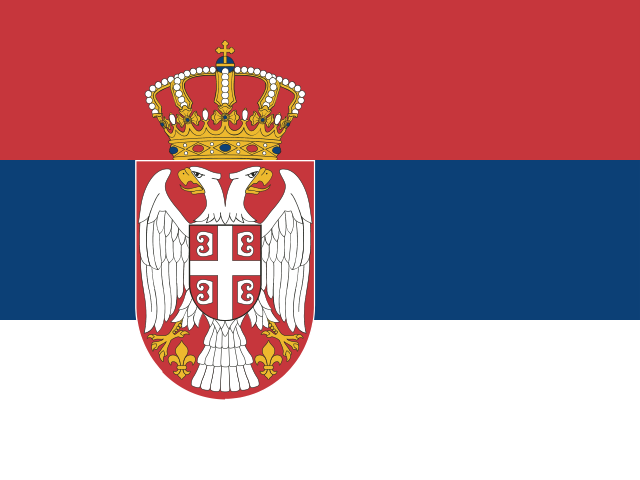
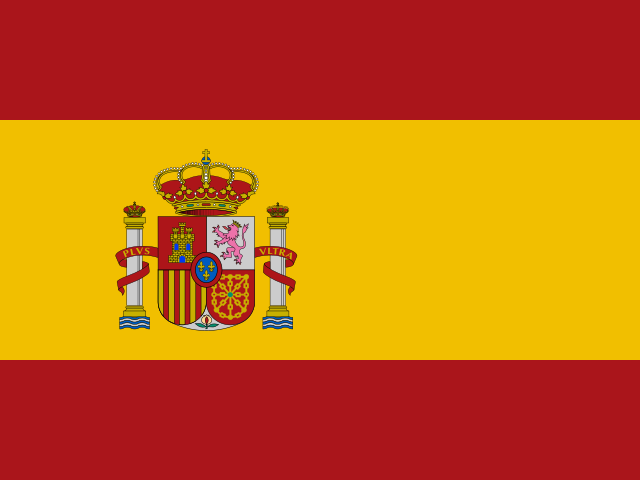
Germany, Spain, Austria, Serbia - Group B (Herning)
Denmark, Portugal, North Macedonia, Romania - Group C (Bærum)
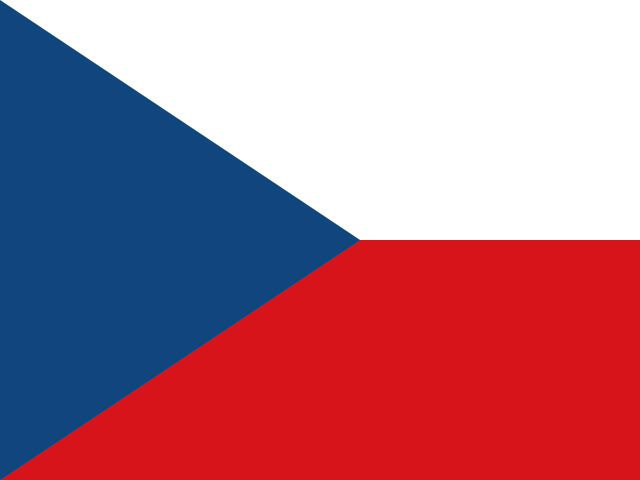
France, Norway, the Czech Republic, Ukraine - Group D (Bærum)
Slovenia, the Faroe Islands, Montenegro, Switzerland - Group E (Malmö)
Sweden, Croatia, Netherlands, Georgia - Group F (Kristianstad)
Hungary, Iceland, Poland, Italy
These 24 teams qualified for the tournament in the following ways:
- Automatic qualifiers: the three host nations — Denmark, Sweden, and Norway — and the reigning champion France, who were seeded directly into the final tournament.
- Qualified through competition: 20 other national teams earned their spots through a formal qualification process held before the finals. A total of 36 national federations entered the qualification phase. After an initial elimination, 32 teams competed in phase 2 qualification groups, each with four teams. Teams played round-robin matches over several months, from late 2024 through May 2025. The top two teams from each group, plus the four best third-placed teams (excluding results against fourth-placed teams), secured qualification for the final tournament.
Structure and Match Format of the 2026 EHF European Men’s Handball Championship
The 2026 EHF European Men’s Handball Championship is structured around three distinct competitive stages, spread across a little over two weeks in January 2026.
- The tournament opens with the preliminary round, running from 15 to 20 January 2026. This is the first group phase, where all 24 teams begin their campaigns and establish early momentum.
- Next comes the main round, held between 22 and 28 January 2026. This phase narrows the field and raises the competitive intensity, as only the strongest teams from the preliminary stage remain in contention for the title.
- The championship then moves into the decisive knockout stage, starting with the semifinals on January 30, 2026, while everything culminates on February 1, 2026, when the bronze medal match and the final are played, determining the full medal podium and the new European champion.
In the preliminary round, teams, as said, are placed into groups of four and compete in a round-robin format, playing each group opponent once. Points are awarded in the usual way (win, draw, loss), and the top two teams from each group advance to the main round.
The main round again uses a group-based system, with two groups of six teams, but results against teams that also advance are carried over from the preliminary phase. This rewards early consistency and prevents teams from having to start the second phase from scratch. Only the top two teams from each main-round group move forward.
The knockout stage is a classic single-elimination format. If a match is tied at the end of regulation time, it proceeds to extra time, and if still undecided, to seven-meter throws. From this point onward, every game is do-or-die, with no second chances.
This structure—group phases followed by sudden-death knockout matches—ensures both competitive fairness and high-stakes drama, making the Men’s EHF Euro one of the most intense and strategically demanding tournaments in international team sport.
The 2026 EHF European Men’s Handball Championship Favorites, Betting Options, and Where to Watch
As with most recent editions of the EHF European Men’s Championship, the 2026 edition enters with a clear group of elite contenders, shaped by both pedigree and current competitive depth.
- France is the benchmark nation in European handball.
- Denmark, playing on home soil, is widely viewed as the most dangerous challenger.
- Sweden remains a classic tournament team.
- Norway completes the top tier of favorites.
- Outside the top four, teams such as Spain, Germany, and Croatia are widely considered dark horses, capable of upsetting any favorite on the right day.
Betting markets for the Men’s EHF Euro 2026 are widely available across licensed European bookies and international sportsbooks. Most established operators offer comprehensive handball coverage, including outright winner markets, group winners, match odds, handicaps, totals (over/under goals), and live in-play betting. In-play betting is particularly popular during EHF Euro matches due to frequent momentum swings, goalkeeper substitutions, and tactical timeouts that can rapidly change odds.
The 2026 EHF European Men’s Handball Championship will be broadcast globally through a mix of free-to-air television, national sports channels, and digital streaming platforms. Across Europe, matches are shown by national broadcasters holding EHF rights in each participating country, ensuring extensive local-language coverage. In addition, the championship is available worldwide via EHFTV, the European Handball Federation’s official streaming service, which provides live matches, replays, and highlights in regions without exclusive TV agreements. This combination of traditional television exposure and centralized digital streaming ensures that fans can follow the tournament live from virtually anywhere, reinforcing the EHF Euro’s status as one of Europe’s most widely viewed indoor sports events.
Pros and Cons of the 2026 EHF European Men’s Handball Championship Favorites
| TEAM | PROS | CONS |
| France | Unmatched tournament pedigree and winning culture Exceptional squad depth across all positions Tactically adaptable and comfortable in long competitions Proven ability to peak in knockout stages | High expectations increase pressure Occasional slow starts in group stages Reliance on veteran leaders may expose fatigue late in the tournament |
| Denmark | Home advantage in front of large, knowledgeable crowds Modern high-tempo attacking system Elite backcourt quality and goalkeeper depth Strong recent results in major tournaments | The pressure of being a host can amplify mistakes Expectations of reaching the final are non-negotiable Injuries or rotation issues could disrupt rhythm |
| Sweden | Extremely disciplined defensive structure Strong tactical identity and cohesion Mentally resilient in close, low-scoring games Partial home support boosts confidence | Less explosive offensively than some rivals Struggles when forced into shootouts Narrow margins leave little room for error against elite attacks |
| Norway | Physical intensity and fast transitions Excellent athletic profile across the squad Strong home-crowd momentum in early stages Capable of overwhelming teams in short bursts | Inconsistency in knockout matches Occasional discipline issues under pressure Less proven in medal-deciding games compared to France or Denmark |

Frequently Asked Questions
Latest Tips
Sydney Swans vs Gold Coast Suns Prediction on April 11, 2026
Here’s a breakdown of the Sydney Swans vs Gold Coast Suns matchup in the 2026 Australian Football League home-and-away season, Round 5, Gather Round. It’s one of the standout interstate tests of the...
Read More
Atlanta Braves vs Cleveland Guardians Prediction on April 10, 2026
Here’s a breakdown of the Atlanta Braves vs. the Cleveland Guardians regular-season matchup for the 2026 Major League Baseball, focusing on the first game of the series on Friday, April 10, 2026. Th...
Read MoreXRock vs Wolves Esports Prediction on April 9, 2026
This is a meaningful regular-season match because it pairs a mid-table side still trying to steady its campaign with one of the stronger teams in the field – both Chinese sides – in a bo5. The Sprin...
Read MoreKT Rolster vs Nongshim RedForce Prediction on April 9, 2026
This early-season matchup in the League of Legends Champions Korea (LCK) is more important than it might look at first glance. In a format where every best-of-three series contributes directly to gr...
Read MoreLatest News
“Ruler” Hit with Tax Evasion Fine — What Happens Next for LoL Superstar?
One of League of Legends’ most recognizable names has unexpectedly found himself in controversy. Park “Ruler” Jae-hyuk has been fined following a tax dispute in South Korea, and while the financial si...
Read MoreAlberta Prepares to Launch New iGaming Market — What It Means for Sports Betting
Alberta is on the verge of a major shift in its gambling landscape, as the province moves closer to launching a fully regulated iGaming and online sports betting market. Long dominated by a single gov...
Read MoreCS2 Player “nifee” Banned for Match-Fixing — Handed Down 4-Year Suspension
The Counter-Strike 2 scene has been hit by another integrity scandal, with Dmytro “nifee” Tediashvili receiving a four-year ban after an ESIC investigation uncovered match-fixing activity tied to bett...
Read MoreSteven Gerrard Joins WE88 as Global Ambassador Ahead of World Cup 2026
Football icon Steven Gerrard is stepping into a new role off the pitch, joining WE88 as a global brand ambassador in a move that aligns closely with the build-up to the 2026 FIFA World Cup. The former...
Read More