Morocco, Senegal & Ivory Coast: Africa’s Best Bets at World Cup 2026

Contents
- Morocco, Senegal & Ivory Coast: Africa's Best Bets at World Cup 2026
- Morocco — Africa’s Most Complete Team?
- Senegal — Built for Tournament Football
- Ivory Coast — The 2023 AFCON Champion Ready to Make Its Mark
- Comparing Africa’s Three Biggest Hopes
- Dark Horse Potential vs Realistic Expectations
- Final Verdict — Who Is Africa’s Best Bet?
- Conclusion
- Frequently Asked Questions
KEY TAKEAWAYS:
- Morocco is Africa’s most complete package — Regragui’s inherited defensive structure, Hakimi’s attacking threat, and the psychological maturity gained from Qatar 2022 make it the continent’s safest bet to reach the latter stages of the tournament.
- Senegal’s physical profile is uniquely suited to tournament football — Pape Thiaw’s side doesn’t need to outplay opponents; it outworks and outlasts them, and with Mané and Koulibaly still in the squad, it retains the individual quality to win matches against elite opposition.
- Ivory Coast is the wildcard the draw doesn’t want — the 2023 AFCON champion, a proven ability to win under pressure, and an attack built around Haller, Adingra, and Kessié make “The Elephants” the most dangerous, unpredictable force Africa sends to 2026.
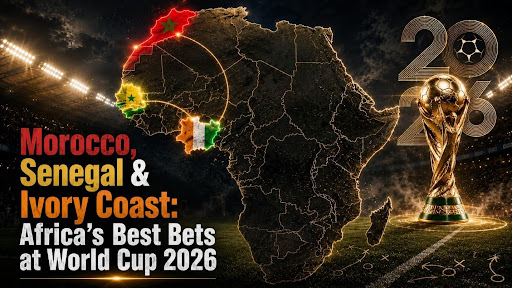
Among the 10 continental qualifiers, three teams stand apart as the most dangerous Africa World Cup 2026 contenders: the reigning continental champion, Morocco, whose semifinal run in Qatar rewrote the script entirely; an AFCON finalist (whose title was taken away by administrative decision), Senegal, a physically imposing, tactically disciplined side built for the grind of tournament football; and Ivory Coast, the 2023 African champion who arrives at 2026 with momentum, quality across the pitch, and a point to prove on the global stage.
Their strengths differ sharply — Morocco brings tactical discipline and elite-level structure, Senegal brings physicality and tournament experience, and Ivory Coast brings a golden generation peaking at exactly the right moment — but all three represent genuine threats to go deep into the knockout rounds. Fans already exploring potential tournament outcomes are also comparing different World Cup betting sites ahead of the draw.
Morocco — Africa’s Most Complete Team?
When Walid Regragui’s side dismantled Spain on penalties, outmuscled Portugal, and pushed France to the limit in Qatar, the footballing world scrambled for explanations. Tactical genius. Team spirit. A nation united behind its players. All of it was true, and none of it was accidental. Morocco’s 2022 run wasn’t a bolt from the blue — it was the visible payoff of a long-term project finally arriving on the biggest stage. Three years on, the project has not stalled, even under Regragui’s successor, Mohamed Ouahbi. It has matured.
Why Morocco Could Go Even Further Than 2022
When Morocco reached the semifinal of the 2022 World Cup in Qatar, becoming the first African and Arab nation ever to do so, the world treated it as a miracle. It wasn’t. It was the product of years of structural investment, a cohesive coaching philosophy under Walid Regragui, and a squad packed with players from elite European clubs who had been waiting for the right collective framework. They beat Spain on penalties, dismantled Portugal, and were only edged out by an experienced French side. That’s no longer a story about surprise — it’s a baseline.
Heading into the Africa World Cup 2026, Morocco arrives as a team with expectations rather than novelty on their side. The psychological shift matters enormously in knockout tournaments. They aren’t trying to prove anyone wrong anymore; they are trying to fulfill a genuine ambition. Regragui has maintained remarkable stability within the setup, retaining the core group while gradually integrating younger talent. He left a heavy legacy to Mohamed Ouahbi. The team’s experience against top-tier European opposition — in Champions League football, in internationals, and in that Qatar run — means pressure situations are no longer unfamiliar territory.
Playing in North America also helps. Morocco’s vast diaspora across the United States and Canada means “The Atlas Lions” will enjoy hostile-territory crowd support almost wherever they play, a factor that proved significant in Qatar and could be even more pronounced in 2026.
Morocco’s Tactical Identity
Morocco is one of the most tactically coherent sides in international football, regardless of confederation. They operate in a compact mid-block, denying space between the lines and forcing opponents into wide areas where Morocco’s defensive shape is at its most suffocating. They are extraordinarily difficult to break down — only three goals conceded in seven Qatar matches, including against Belgium, Spain, Portugal, and France.
Going forward, the key is tempo and transition. Achraf Hakimi, the PSG right-back (full-back), remains the single most important attacking outlet — his ability to combine elite defensive positioning with explosive, direct runs into the final third gives Morocco a genuine threat from depth. Sofyan Amrabat, operating as a holding midfielder, is the engine of the press and the first line of defense in transition. With Hakim Ziyech, Youssef En-Nesyri, and Azzedine Ounahi providing different creative and physical options in the forward areas, Morocco’s attack has more variation than critics acknowledge.
Pragmatic, well-drilled teams tend to outperform their league-season pedigree at World Cups. The tournament format — knockout pressure, compressed schedules, the weight of single elimination — rewards discipline and organization above free-flowing football. Morocco embodies that principle as well as any team in this edition.
Morocco’s Biggest Concerns
No team is without vulnerabilities. Morocco’s reliance on defensive perfection means that any lapse — an injury to a key center-back, a set-piece conceded, a red card — can unravel a match quickly. Their attacking production remains thin in volume: they don’t consistently create a high number of clear-cut chances, making them vulnerable in matches where they need a second or third goal.
En-Nesyri leads the line but isn’t a 25-goal-a-season striker at the highest level, and depth behind the starting eleven — particularly in wide creative areas if Ziyech is off form — is a legitimate concern. Some members of their 2022 core are also entering their late-to-mid-twenties, meaning 2026 may be the last genuine window for this specific group.
Senegal — Built for Tournament Football
If Morocco is the team you respect, Senegal is the team you fear. There’s a grittiness to how they operate at major tournaments — a refusal to be outworked, outrun, or outfought — that makes them uniquely awkward opponents regardless of the quality lined up against them. They don’t dazzle. They don’t need to. Aliou Cissé has spent the better part of a decade building a side that wins through collective discipline and physical attrition, and the results speak for themselves: AFCON champions before continental confederation decided differently, consistent qualifiers, and a squad that has never once looked out of its depth on the international stage. The road Pape Thiaw has taken, too.
Why Senegal Remains Africa’s Most Physically Dominant Side
Senegal’s identity in international football is unmistakable: athletic, aggressive in and out of possession, direct, and mentally resilient. It’s a side that simply doesn’t wilt under physical pressure, and in a 48-team World Cup where matches in the knockout rounds can turn on fitness and mentality as much as technical quality, that’s a significant asset. Aliou Cissé has managed this project for nearly a decade, and the continuity he has brought — in terms of squad culture, tactical principles, and leadership hierarchy — is as underappreciated as any coaching job in African football.
Senegal’s AFCON pedigree and long run of tournament deep dives have hardened this group. They know how to win ugly. They know how to manage a 1–0 lead. They know how to raise their level when the occasion demands it, and they have done it repeatedly against high-quality opposition. That kind of tournament intelligence can’t be manufactured quickly. As the Africa World Cup 2026 threat, Senegal arguably represents the most battle-tested outfit on the continent.
Senegal’s Key Players and Style
Sadio Mané remains the figurehead — his work rate, his ability to drag defenders out of position, and his leadership in the dressing room are all central to what Senegal does. After injury-disrupted seasons at the club level, the question heading into 2026 is whether Mané arrives fit and sharp enough to be the decisive player he can be on his best days. When he is, Senegal becomes a genuinely different proposition going forward.
At the back, Kalidou Koulibaly has been one of the most physically dominant center-backs in world football for the better part of a decade. His leadership of Senegal’s defensive line — organizing, sweeping, and winning aerial duels — is the backbone of their structure. The midfield engine room is deep and aggressive, with younger players pushing through to establish themselves in the Premier League, Ligue 1, and the Bundesliga. Set-pieces are a weapon: Senegal is dangerous from corners and free-kicks, and in a tournament where matches can come down to a single moment, that’s a consistent threat.
The Problem Senegal Still Has to Solve
The persistent question with Senegal is what happens when opponents sit deep and deny them the vertical game they prefer. Against compact, low-block sides willing to absorb pressure and hit on the counter, Senegal can look uncomfortable — lacking the intricate combination play needed to unlock packed defenses in tight spaces. Their game is built on physical dominance, but at a World Cup where knockout-round opponents will be well-organized and well-coached, there will be matches where grinding that dominance into actual chances requires a level of creativity the squad has not always produced consistently. Squad depth beyond the first-choice eleven, particularly in wide-creative positions, is also less convincing than Morocco’s at its peak.
For fans looking to assess these dynamics before the tournament, checking the best betting sites for World Cup markets will reveal how the bookmakers view Senegal’s ceiling—the outright and quarterfinal odds tend to reflect this ceiling/floor tension that defines their campaign.
Ivory Coast — The 2023 AFCON Champion Ready to Make Its Mark
Nobody gave them a chance. After a dismal group stage that left it on the verge of elimination on home soil, Ivory Coast sacked its coach, handed the reins to Emerse Faé — then 40 years old and barely established at the senior level — and somehow won the whole thing back in 2023. Seven matches, backs against the wall from the opening week, and they lifted the AFCON trophy in front of their own fans in Abidjan. That’s not a fluke. That’s a team that knows how to survive, how to reset, and how to find something extra when the tournament demands it. Heading into 2026, that experience sits at the core of everything Ivory Coast brings to North America.
Ivory Coast’s Ceiling Might Be Higher Than Anyone Expects
There’s a version of the Africa World Cup 2026 where the Ivory Coast is the continent’s biggest story. It arrives as an African powerhouse — the winner of 2023 AFCON on home soil in one of the most dramatic tournament turnarounds in recent memory, hauled back from the brink of group-stage elimination before Emerse Faé took the reins mid-competition and guided it all the way to the title. That kind of resilience — the ability to absorb a crisis, reset, and win seven consecutive matches under maximum pressure — isn’t a coincidence. It’s character, and character travels to World Cups.
“The Elephants” are no longer trading on the legacy of Didier Drogba and the mid-2000s golden generation. This is a genuinely new group, built around players who are winning at the highest level in European club football and who are entering their collective prime at exactly the right moment. The narrative writes itself: one-time AFCON champion, squad depth across every position, and a coach who proved under fire that he can manage a tournament.
Ivory Coast’s Attack and Key Players
Sébastien Haller leads the line and brings a profile that’s difficult to handle at the international level — physically strong, intelligent in his movement, and remarkably composed in the box for a striker who spent much of 2022 fighting testicular cancer before returning to elite football with Borussia Dortmund. His story alone carries weight, but his performances have backed it up at every level.
Behind him, Simon Adingra is one of the most exciting wide forwards in European football. His pace, directness, and ability to beat defenders one-on-one in wide areas give the Ivory Coast a consistent attacking outlet that can unsettle any defensive shape. Franck Kessié in midfield provides the physical and technical platform — a box-to-box operator with Champions League experience and the ability to dominate in both phases. Ibrahim Sangaré adds defensive solidity and power in the engine room, making the Ivory Coast’s midfield one of the most balanced in African football.
Going forward, the combination of pace in wide areas, physical presence centrally, and a technically assured midfield gives the Ivory Coast multiple routes to goal against different types of opposition. It’s not a one-dimensional team, and Faé has shown he can adapt tactically across a tournament rather than committing rigidly to a single system.
What Could Still Go Wrong
The concern with the Ivory Coast is consistency across a full seven-match tournament campaign. Their AFCON victory three years ago was extraordinary but also fragile — they needed results to go their way in the group stage and rode momentum and emotion as much as tactical dominance through the knockout rounds. Against the elite European and South American sides they’d face in a World Cup quarterfinal or beyond, the margins are thinner, and the execution demands are higher.
Defensively, they can be exposed in transition against teams with genuine pace and directness — their high defensive line creates space behind that quick forwards can target. There are also legitimate questions about whether Faé, despite his AFCON triumph, has the international tournament management experience to navigate five or six weeks of pressure at a World Cup without the emotional fuel of a home crowd. These aren’t disqualifying concerns, but they are real ones.
Comparing Africa’s Three Biggest Hopes
| Team | Biggest strength | Biggest weakness | Realistic ceiling |
|---|---|---|---|
| Morocco | Defensive structure & tactical cohesion | Limited attacking depth and output | Semifinals |
| Senegal | Physical dominance & tournament mentality | Creativity against low blocks | Quarterfinals |
| Ivory Coast | AFCON-winning momentum & attacking quality | Defensive exposure & consistency questions | Quarterfinals/semifinals |
Dark Horse Potential vs Realistic Expectations
The question of whether an African team can win the World Cup outright is no longer absurd. It was, arguably, 15 years ago. It’s not now. The gap between elite African and elite European or South American squads has narrowed structurally: more African players are winning Champions Leagues, La Liga titles, and Premier League medals. Tactical development at the international level has accelerated. And the expanded format means momentum teams get more matches to find their rhythm and peak at the right time, which historically suits cohesive sides rather than technically supreme ones.
None of the three teams discussed here is likely to win the tournament. But Morocco reaching the final is not a fantasy, and the Ivory Coast winning four knockout matches with a fit, firing squad is not beyond the boundaries of realistic football possibility. Africa World Cup 2026 is the edition where continental progress becomes definitive rather than episodic.
Final Verdict — Who Is Africa’s Best Bet?
Morocco remains the safest pick. Tactical clarity, coaching continuity, tournament experience, and a home-continent crowd advantage across North America make them the most structurally sound team Africa sends to 2026. Their semifinal floor is genuinely achievable if the defensive core stays fit.
Senegal is the most battle-tested. Thiaw’s squad knows how to win in high-pressure environments. Mané and Koulibaly remain world-class operators when fit, and their physical profile suits the grind of seven-match tournament football.
Ivory Coast carries the most compelling narrative. A squad with Haller, Adingra, and Kessié operating at or near their peak, and a coach who has already won a tournament against the odds — if the defensive structure holds and Faé can replicate his AFCON management across a longer campaign, “The Elephants” are the team best placed to deliver Africa’s next major surprise.
Conclusion
African football isn’t in a golden generation phase. It’s in a systemic elevation phase, and the difference matters. Morocco in 2022 was not a once-in-a-generation anomaly. It was a preview of what’s coming. The 2026 tournament in North America may be the edition where that prediction gets confirmed in full.
Frequently Asked Questions
Latest Tips
France vs Italy
The FIVB Men’s Volleyball Nations League (VNL) is one of the most prestigious annual international volleyball competitions, bringing together the world’s top national teams across several weeks of eli...
Read More
Uzbekistan - Colombia
One of the two opening matches in Group K of the 2026 FIFA World Cup between Uzbekistan and Colombia presents a fascinating, high-stakes collision between Asian tactical discipline and South American ...
Read MorePortugal - Congo
The 2026 FIFA World Cup Group K opening match between Portugal and DR Congo represents a massive clash of styles, experience, and footballing history. As you prepare to watch the action unfold, you ca...
Read MoreEngland - Croatia
Few group-stage fixtures at this World Cup carry the emotional and competitive weight of this one. Before diving in, if you want to compare odds and markets from top-rated sportsbooks for this fixture...
Read MoreLatest News
One-time TI champions Tundra Esports End Competitive Operations to Pursue Media-First Future
Tundra Esports has announced one of the most surprising pivots in recent eSports memory, stepping away from competitive gaming entirely and repositioning itself as a media-focused brand. The move come...
Read More1xBet Wins SiGMA Europe Awards for Best Sports Betting Operator in 2026
Global betting operator 1xBet has been crowned Best Sports Betting Operator 2026 at the SiGMA Europe Awards, which took place in Valletta, Malta. The ceremony, held at the historic Casino Maltese, bro...
Read MoreManchester United and Betway Strike Major Sponsorship Deal as Iconic Club’s Commercial Strategy Evolves
Manchester United have agreed a new sponsorship partnership with Betway, marking another significant commercial move for one of football’s most recognizable brands. The agreement adds Betway to United...
Read MoreFIFA World Cup 2026 to Debut Major Rule Changes: VAR Powers Expanded, Time-Wasting Targeted…
The 2026 FIFA World Cup is set to become the testing ground for some of the most significant football law changes in recent years after the International Football Association Board (IFAB) approved a p...
Read More